Mithridates' Antidote: The Nuclear Threat and the Iodine Tablet

Mithridates, the Black Sea king remembered for his fear of poison, is said to have taken small doses of poison every day. The ruler of Pontus wanted one thing: a single antidote that would work against every poison. The mixture Pliny described came to bear the king's name, mithridatium. The ending of the story is a little ironic. Defeated by Rome in 63 BC, Mithridates tried to poison himself, and the poison failed.
Two thousand years later, we are still looking for one tablet against every danger. These days we hand that role to the iodine tablet. According to an April 2026 report by Iran International, 180,000 iodine tablets were distributed to residents of Bushehr, home to Iran's only nuclear power plant. The Doomsday Clock was set to 85 seconds to midnight at the start of this year. In Turkey, searches for "iodine tablet" spike during crisis months. Monthly searches climbed to 27,100 in June 2025 and fell back to 1,600 a month later.
Let me admit it up front: the iodine tablet cannot be Mithridates' antidote. The WHO also writes that the tablet should not be seen as a "universal radiation antidote". As pharmacological prophylaxis against a nuclear threat, its job is very narrow. It protects the thyroid and nothing else.
So how does it work? The thyroid gland collects iodine from the blood to make hormones, and it does not check whether that iodine is radioactive. One of the most important substances released in a reactor accident is radioactive iodine, especially iodine-131. Inhaled, or swallowed with contaminated milk and vegetables, iodine-131 travels to the thyroid like ordinary iodine, accumulates there and irradiates the gland from the inside.
Think of the thyroid as a small hotel. The receptionist never asks a guest for ID. The tablet books every room in advance with non-radioactive iodine. Radioactive iodine that arrives later finds no vacancy and leaves in the urine.
The hotel's walls end there. The lungs, bone marrow and skin are outside this protection. The tablet does nothing against caesium, strontium or external irradiation either. The CDC writes that the tablet does not reverse damage already done to the thyroid and does not protect it completely.
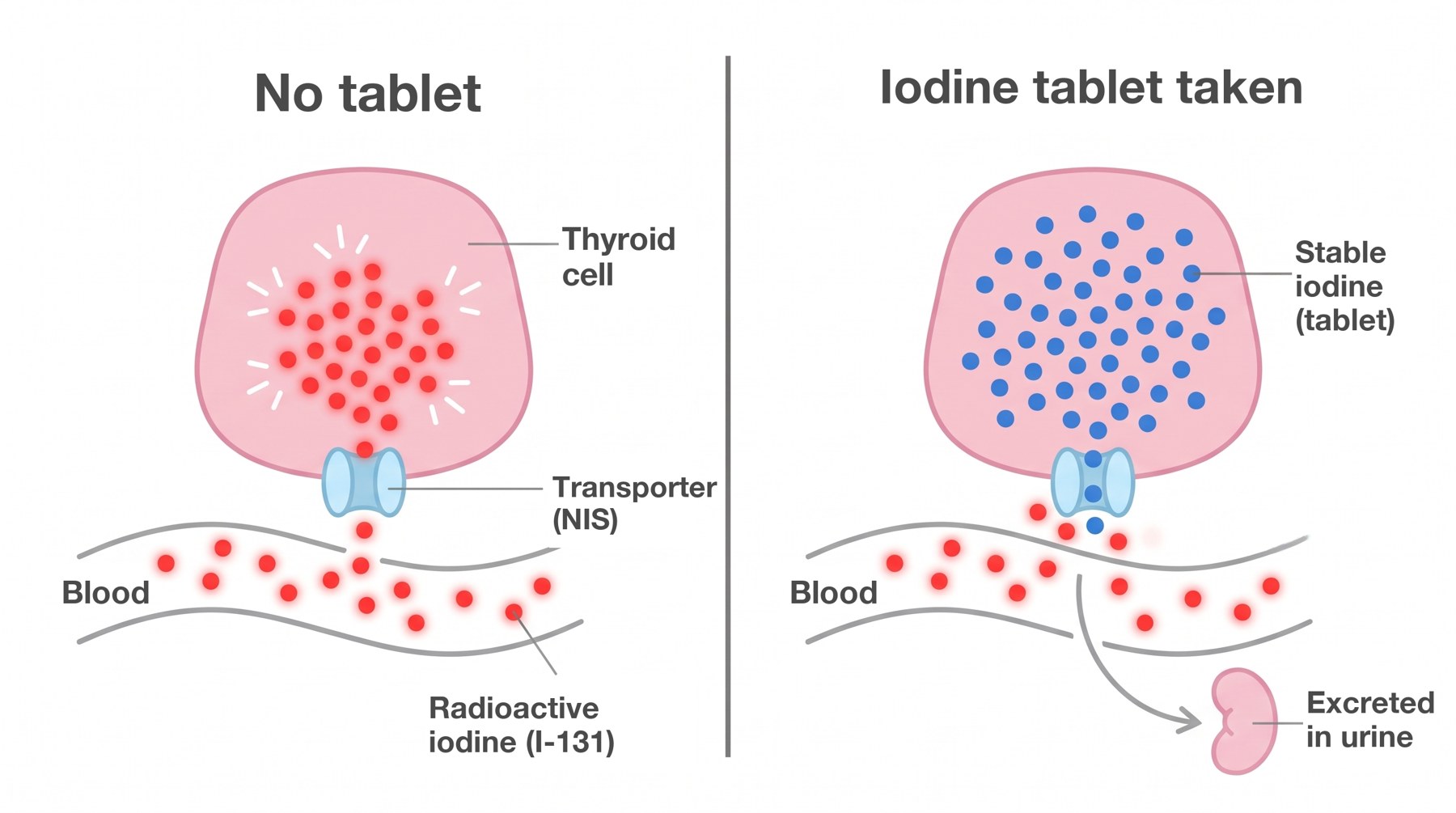
The tablet fills the iodine transporter of the thyroid cell with stable iodine. Radioactive iodine cannot get in and is cleared by the kidneys.
A bomb or a power plant accident?
The tablet is strongest in a reactor accident. There, the main threat is radioactive iodine in the air and in food, and the organ to protect is the thyroid.
In a nuclear detonation, the biggest threat for most people outside the blast zone is radiation from fallout. A 2022 CDC update states plainly that the tablet does not protect against it. After a nuclear detonation, the first advice is to get inside, stay inside and follow official announcements. The tablet comes later, if officials say so.
Most of what we know comes from the 1986 Chernobyl accident. After the accident, thyroid cancer rose sharply among children in Belarus and Russia. In the 2005 study by Cardis and colleagues, risk increased with the dose the thyroid received, and among those who had taken potassium iodide the radiation-related risk fell to about one third. In the same days Poland distributed about 18 million doses. Serious side effects were rare, and severe reactions occurred in two adults. Both knew they were hypersensitive to iodine and took the tablet anyway out of fear.
Timing the tablet
The tablet's effect depends largely on timing. According to the WHO, the best window runs from 24 hours before exposure to 2 hours after it begins. Taking it up to 8 hours after is still considered reasonable. In the model by Zanzonico and Becker, for an adult with adequate iodine intake, a tablet taken at hour 2 protects the thyroid by about 80% and one taken at hour 8 by about 40%. If more than 24 hours have passed since exposure, the tablet may do more harm than good, because radioactive iodine already in the thyroid is held in the gland longer.
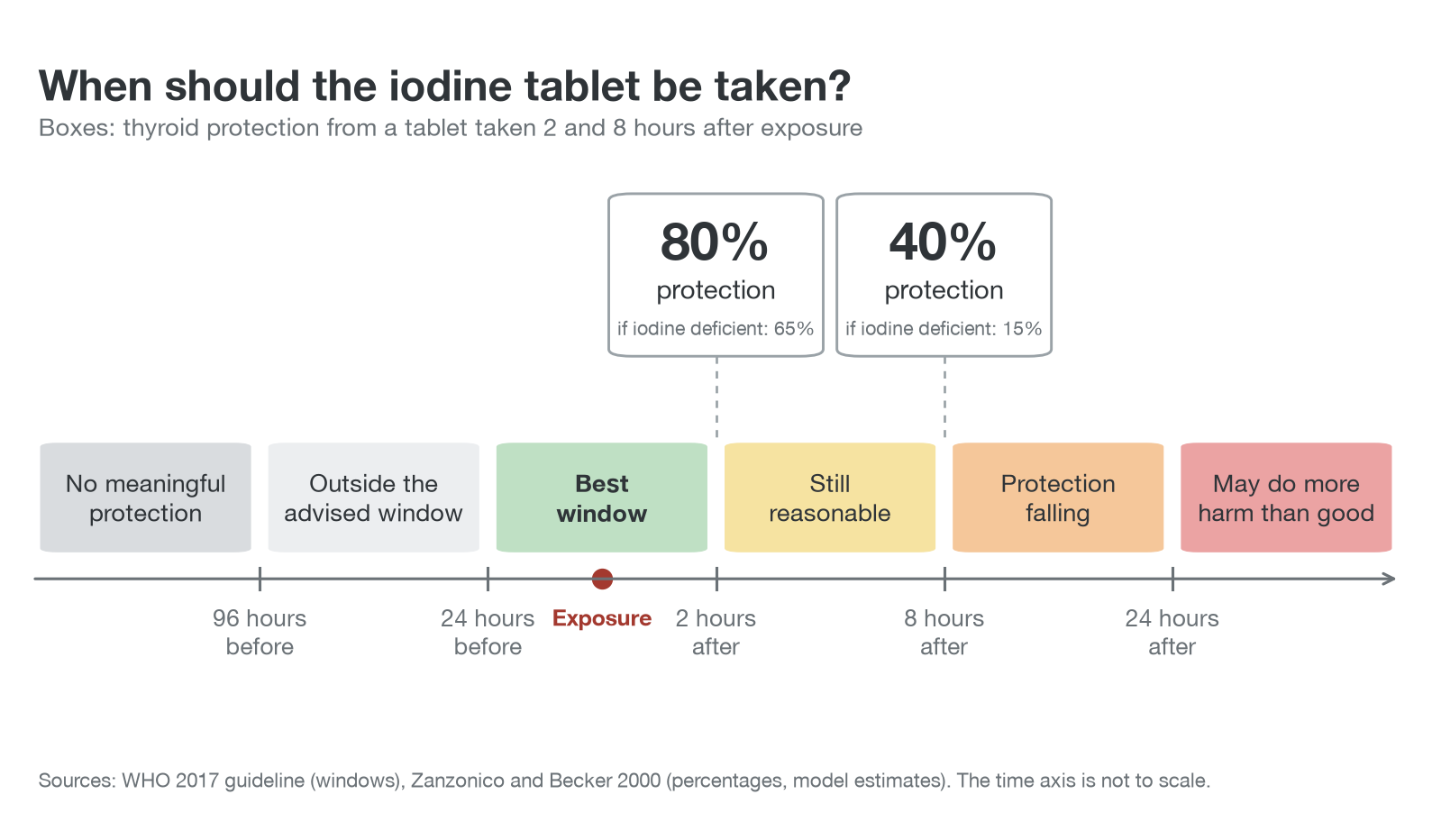
The reverse also holds. A tablet taken 96 hours or more before exposure gives no meaningful protection. So taking a tablet "just in case" on the day the news reports a strike on a facility gains you nothing. When Iran's nuclear facilities were struck in June 2025, the International Atomic Energy Agency reported no rise in radiation levels outside the sites. When a projectile hit the grounds of the Bushehr plant in March 2026, no radiation release was reported either. Anyone who took a tablet on those days gained no protection and took on only the risk of side effects.
Officials are the ones who will tell you when to take it. The CDC also says not to take it unless public health or emergency officials, or your doctor, tell you to. A single dose is usually enough, and protection lasts about 24 hours. I won't drown you in numbers, but I do have to give you the dose table. Here is the WHO single-dose recommendation, together with the FDA's threshold for people over 40:
| Group | Potassium iodide (KI) | Iodine content | Note |
|---|---|---|---|
| Newborn (0-1 month) | 16 mg | 12.5 mg | Priority. Single dose, not repeated |
| Infant (1 month-3 years) | 32 mg | 25 mg | Priority |
| Child (3-12 years) | 65 mg | 50 mg | Priority |
| Adolescent and adult (12-40 years) | 130 mg | 100 mg | |
| Pregnant or breastfeeding | 130 mg | 100 mg | Priority. Single dose, not repeated |
| Over 40 | 130 mg | 100 mg | Only if the expected thyroid dose exceeds 5 Gy (FDA). No repeat dose over 60 |
Tablets can be crushed and mixed into fruit juice, jam or milk for children.
Who benefits most
Children, adolescents, pregnant and breastfeeding women benefit most. After Chernobyl, the rise in thyroid cancer was seen almost entirely in people who were children at the time of the accident, because a developing thyroid is far more sensitive to radiation. Over 40, the picture is different. The FDA recommends the tablet for this age group only if the projected thyroid dose exceeds 5 Gy. For children and pregnant women the threshold is 0.05 Gy, a hundred times lower. Emergency workers involved in rescue or clean-up are a priority regardless of age.
According to the FDA, people who are hypersensitive to iodine and heart patients with nodular thyroid disease should not use the tablet. Caution is also needed in multinodular goitre, Graves' disease and autoimmune thyroiditis.
Does table salt help?
No. To get the 100 mg of iodine in an adult dose from table salt, you would have to eat 4 to 7 kilograms of salt. The CDC says salt and iodine-rich foods should not be used in place of the tablet. When you look at a box labelled "iodine" in a pharmacy, check the unit too. If it says "mcg" or "µg", the product is a nutritional supplement at about one thousandth of the protective dose. Tincture of iodine and povidone-iodine are wound antiseptics and must not be swallowed. In a case reported by Kim and colleagues in 2017, a 47-year-old patient who drank povidone-iodine was admitted to intensive care with acute kidney injury, and kidney function never fully recovered.
Salt's real job comes before the day of an accident. In people with iodine deficiency, the protection of a late tablet falls faster. In the Cardis study, too, the radiation-related risk was about three times higher in iodine-deficient areas. According to a 2022 note from Hacettepe University's Department of Public Health, 66.5% of people in Turkey actually use iodised salt at the table. Iodised salt in the kitchen does not replace the tablet, but it brings the thyroid to that day better prepared.
Should you keep it at home?
Keeping tablets at home may sound like a prepper habit. Having seen the lack of preparedness first-hand during my UMKE (national medical rescue team) deployment after the Kahramanmaraş earthquake, I don't look down on it. The WHO also recommends allowing the public to buy the tablet voluntarily. Properly stored tablets keep their iodine content for five years.
My advice:
- If there are children, adolescents or a pregnant woman at home and you live near a nuclear power plant or a cross-border risk, keeping age-appropriate potassium iodide may make sense.
- Do not take the tablet on your own. Take it when officials announce a radioactive iodine release and tell you when to take it.
- At a nuclear detonation warning, don't reach for the tablet; get inside and stay inside first.
- If you are over 40, the tablet is not a priority for you; save it for children and pregnant women.
- If you have thyroid disease, an iodine allergy or heart disease, do not use it without talking to your doctor.
- Make sure the box says "mg". A microgram supplement does not protect.
- Use iodised salt.
Mithridates was looking for one mixture against every poison. The tablet we have is far more modest: it protects one organ, against the radioactive form of one element, within a window of a few hours. At the right time and in the right person, it works. Let's see where searches climb in the next crisis.
Note: This article is for information only and is not medical advice. Discuss decisions about medication with your doctor. In a radiation emergency, official instructions come first.
Search data: OpenSEO (Google Ads estimates), Turkey, retrieved November 2026. Figures are monthly estimates.
References
- World Health Organization. Iodine thyroid blocking: Guidelines for use in planning for and responding to radiological and nuclear emergencies. Geneva: WHO; 2017. ISBN 978-92-4-155018-5. who.int
- Cardis E, Kesminiene A, Ivanov V, et al. Risk of thyroid cancer after exposure to ¹³¹I in childhood. J Natl Cancer Inst. 2005;97(10):724-732. doi:10.1093/jnci/dji129
- Nauman J, Wolff J. Iodide prophylaxis in Poland after the Chernobyl reactor accident: benefits and risks. Am J Med. 1993;94(5):524-532. doi:10.1016/0002-9343(93)90089-8
- Zanzonico PB, Becker DV. Effects of time of administration and dietary iodine levels on potassium iodide (KI) blockade of thyroid irradiation by ¹³¹I from radioactive fallout. Health Phys. 2000;78(6):660-667. doi:10.1097/00004032-200006000-00008
- Kim CS, Kim SS, Bae EH, Ma SK, Kim SW. Acute kidney injury due to povidone-iodine ingestion: A case report. Medicine (Baltimore). 2017;96(48):e8879. doi:10.1097/MD.0000000000008879
- U.S. Food and Drug Administration. Frequently Asked Questions on Potassium Iodide (KI). fda.gov
- Centers for Disease Control and Prevention. Potassium Iodide (KI). cdc.gov
- Centers for Disease Control and Prevention. Radiation and Health Newsletter. July 2022. archive.cdc.gov
- National Institutes of Health, Office of Dietary Supplements. Iodine: Fact Sheet for Consumers. ods.od.nih.gov
- Tezcan Honca D, Bağcı Bosi T. İyot Yetersizliği Hastalıklarının Önlenmesi Haftası [Iodine Deficiency Disorders Prevention Week]. Hacettepe University Faculty of Medicine, Department of Public Health. 2022. halksagligi.hacettepe.edu.tr
- Turkish Food Codex, Salt Communiqué. mevzuat.gov.tr
- 'Doomsday Clock' ticks closer to midnight. PBS NewsHour. 27 January 2026. pbs.org
- Mithridates' Poison Elixir: Fact or Fiction? World History Encyclopedia. worldhistory.org
- Iran distributes 180,000 iodine tablets to Bushehr residents. Iran International. 7 April 2026. iranintl.com
- IAEA. Statement on Bushehr, X. 27 March 2026. x.com
- IAEA's Grossi Says Iran Nuclear Plant Strike Risks Crossing 'Reddest Line'. NucNet. March 2026. nucnet.org
- United Nations News. Iran-Israel crisis: IAEA chief calls for access to damaged nuclear sites. 23 June 2025. news.un.org