Judas' Kiss: The Story of a Chimera and an Undying Flame
Anyone who has traveled to Antalya, Türkiye, knows the place: Yanartaş. Up on the slopes of Mount Olympos, above the village of Çıralı, a fire has been burning for thousands of years. No one lit it; gas seeping from beneath the earth keeps the rocks ablaze. The ancient Lycians believed this flame was the breath of the Chimera, the monster said to have fallen from the chest of the goddess Athena. Spend a night up there, watching those flames dance among the rocks, and you'll half-believe the legend yourself.
 The Chimera of Arezzo, ca. 400 BC — National Archaeological Museum, Florence; photo: Sailko (CC BY-SA 3.0)
For me, this flame carries another meaning. The same name now inspires one of modern medicine's most exciting molecules: the Chimera. The creature of Homer's Iliad — lion-headed, goat-bodied, serpent-tailed. Three different animals fused into a single body. The molecules called PROTACs take their name straight from here; the acronym gives it away: PROteolysis TArgeting Chimera. Three separate parts meeting in a single molecule — a structure that inevitably echoes the Chimera's three heads.
But let me confess: much as I like the Chimera metaphor, another story always comes to mind when I try to explain these molecules. This is the comparison I feel closest to. Judas' kiss.
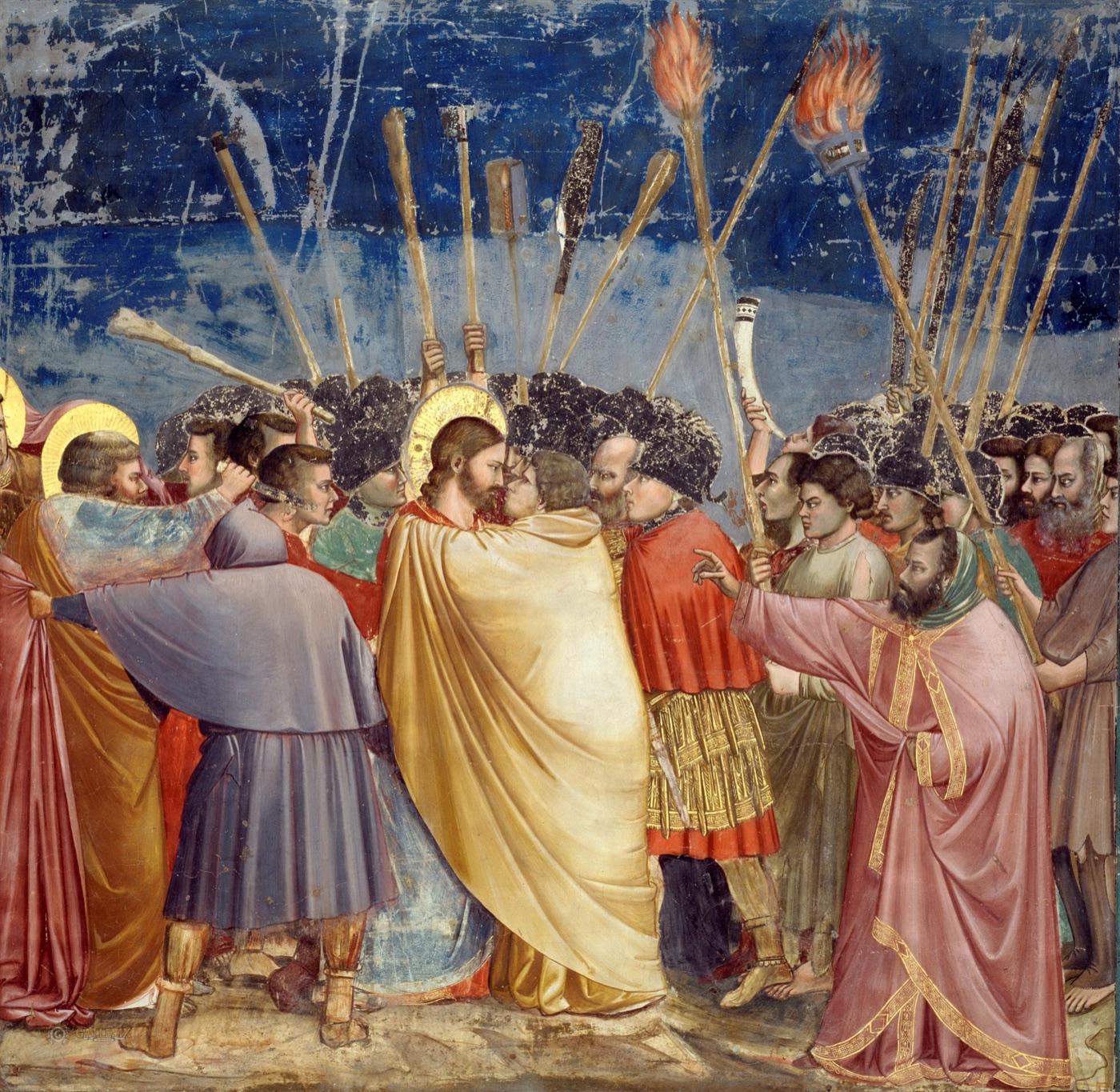 Giotto di Bondone, "The Kiss of Judas," 1305 — Scrovegni Chapel, Padua (public domain)
You know the scene from the Gospels. In the Garden of Gethsemane, Judas approaches Jesus and kisses him. That kiss is not an act of affection; it is a signal. "This is the man to seize," Judas tells the Roman soldiers. The kiss itself harms no one — the real work is done by the legionaries who receive the signal. No metaphor is perfect, but PROTACs work remarkably like that. They plant a kiss on a target protein inside the cell: "This protein." Then they step aside and leave the work to the cell's own demolition crew, the ubiquitin-proteasome system. Like Roman legionaries.
How does it happen? Take a look at this simple diagram:
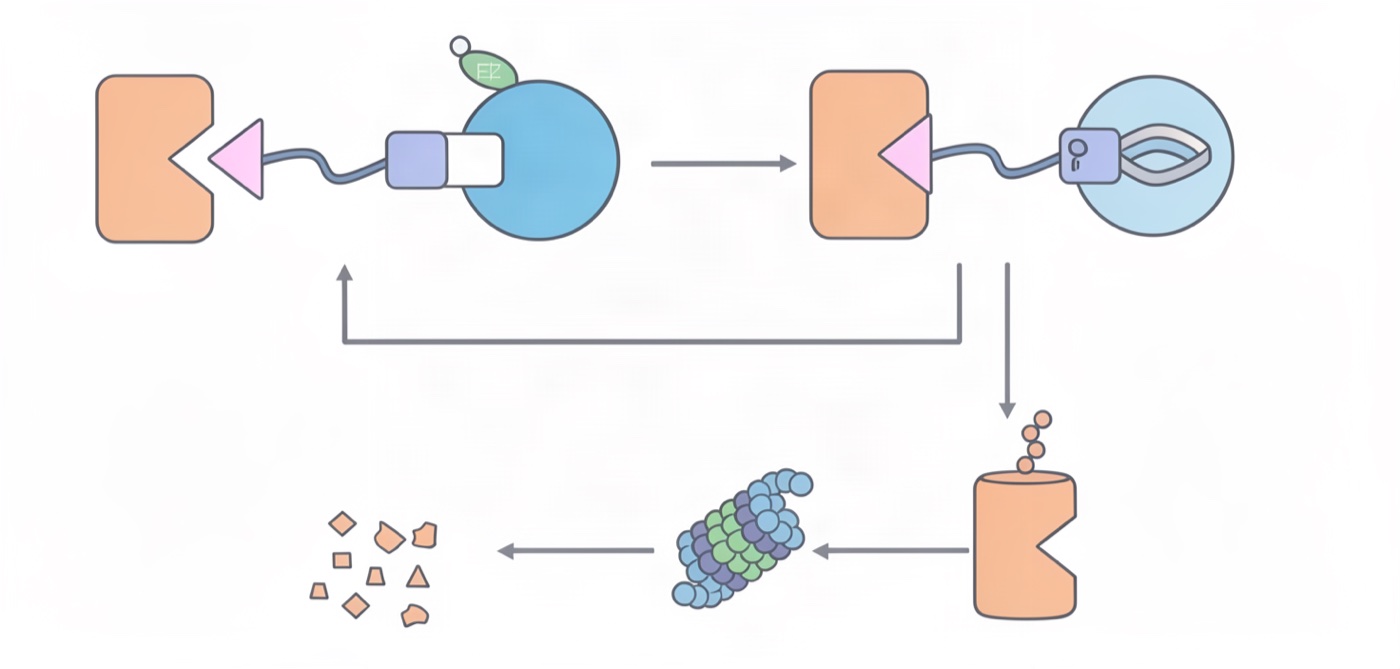 The PROTAC mechanism: the target protein is brought to the E3 ligase, tagged with ubiquitin, and destroyed in the proteasome (illustration)
One end of the molecule carries a piece that recognizes the target protein — say, the estrogen receptor in breast cancer. The other end carries a piece that summons the cell's demolition machine, an enzyme called an E3 ligase. Between them runs a thin linker arm. One side grips; the other side signals. That is the whole trick: a PROTAC can hold two proteins at once, building a bridge between them. Across that bridge, the E3 ligase tags the target protein with little "death labels" — ubiquitin chains. The tagged protein is then recognized by the proteasome, the cell's giant demolition complex, and broken into fragments. Protein gone. Job done.
The most beautiful detail is that the molecule itself never stays in the game. The hand that planted the kiss is released, free to find a new target and repeat the process. A single PROTAC molecule can destroy dozens of proteins in sequence. It is a catalytic effect.
This is exactly where the difference from classical drugs begins. A conventional drug sticks to its target protein and inhibits it. The protein stays there, merely silenced. Stop the drug and the protein is free again; disease resumes where it left off. A PROTAC carries a different philosophy: don't inhibit — destroy. With the protein gone, there is nothing left to resume; the cell must rebuild it from scratch. Pharmacologists call this "event-driven" rather than "occupancy-driven" pharmacology. For those fighting resistant cancers, this conceptual shift is hope: with classical drugs, the target protein mutates and stops recognizing the drug; but the logic of destruction works on mutant proteins too — they still get tagged and destroyed.
Of course, a powerful idea carries difficulties with it. These molecules are far larger than classical drugs; getting them into the bloodstream after oral dosing is a serious piece of chemistry. Push the dose too high and the effect paradoxically drops — the parts separate and can no longer form the bridge. And destroying a protein is a harsher intervention than silencing it; destroy the wrong one and things get messy. But this is exactly how science moves forward — struggle by struggle.
I can't pass over how long this journey has been. The first PROTAC idea was born in Craig Crews' laboratory in 2001. Back then, people said these molecules were "too big and too fragile to ever become drugs." For years they only showed promise in cell cultures and animal experiments; in the hard test of the clinic, many fell by the wayside. Not every story ends well — last year, a company quietly terminated its phase 2 PROTAC candidate. The biotechnology graveyard is not called a graveyard for nothing.
But this year, something changed. In May 2026, the FDA approved the first PROTAC in history: vepdegestrant. For breast cancer patients who had developed resistance to endocrine therapy — precisely the group where other drugs had run out of answers. I won't drown you in numbers; those who are curious can read the FDA's announcement. Let me just say this: in a phase 3 trial, it showed a meaningful advantage over the current standard of care, and a genetic test was approved alongside it — to find the right patients. That was the moment a 25-year-old idea moved from "theory" to "treatment."
And it is only the beginning. The same logic now has molecules in the clinic that destroy the androgen receptor in prostate cancer, target inflammation enzymes in autoimmune disease, wipe out BTK in B-cell malignancies — even reach for KRAS, once declared "undruggable." The Chimera's three heads became a drug's three parts; now those parts are knocking on every door of medicine.
The fire at Yanartaş has burned for thousands of years. This idea doesn't look like it's going out either. After more than two decades of development, that approval in May 2026 proved this technology will not be another funeral in the biotechnology graveyard. Let's see what the coming days bring.
Note: This article is for informational purposes only and is not medical advice. Always discuss medication decisions with your physician.